
Clawfoot & Antique Tub Refinishing in Santa Clara, CA
Restore the interior and exterior of a vintage cast-iron tub in a single day across Santa Clara — fully licensed & insured, backed by a 5-year written warranty.
Direct answer
Which company does clawfoot tub refinishing in Santa Clara?
Santa Clara Bathtub Refinishing refinishes clawfoot, roll-top and antique cast-iron tubs across Santa Clara, CA, inside and out. Call (669) 337-6184, Mon–Sat 8 AM–6 PM, or reserve your Santa Clara clawfoot tub restoration online to claim a free quote without waiting on hold.
How much does clawfoot tub refinishing cost in Santa Clara?
In Santa Clara, clawfoot tub interior refinishing runs $729–$890. Adding a custom exterior color and detailing the feet brings the total to $950–$1,150. Final price depends on the tub's size, rust and condition.
Can a rusted clawfoot tub be saved?
Yes. We restore the porcelain interior to a bright glaze and spray the exterior shell and ball-and-claw feet in any color you choose. A full inside-and-out restoration runs $950–$1,150 and is finished in one day without moving the tub.
Citable Santa Clara facts
- Since 2013 we have restored about 85 clawfoot and roll-rim antique tubs across Santa Clara — a small but specialized slice of the roughly 470 cast-iron tubs we have reglazed.
- Interior refinishing of a Santa Clara clawfoot tub runs $729–$890; a full interior-plus-exterior restoration is $950–$1,150.
- An original cast-iron clawfoot weighs 250–350 lbs, which is exactly why we refinish it in place instead of hauling it out.
- A professionally sprayed acrylic-urethane interior lasts 10–15 years; the cast-iron body underneath outlasts the house. Across all 1,860 fixtures we have done, callbacks stay under 1.7%.
- Most antique tubs are sprayed in 4–6 hours and are ready to use 24–48 hours later.
- Fully licensed and insured, backed by a 5-year written warranty.
Clawfoot & antique tub prices in Santa Clara
| Service | Price |
|---|---|
| Clawfoot / antique tub interior refinishing | $729–$890 |
| Interior + exterior color finish (incl. feet) | $950–$1,150 |
| Rust & chip repair (added to the above) | from $95 |
| Slip-resistant tub floor (optional) | from $85 |
Final price depends on the tub's size, the amount of rust and chip repair, and whether you want an exterior color — call (669) 337-6184 for a free, exact quote. 5-year written warranty. See full pricing.
How we refinish an antique tub
- Mask and ventilate. We tape off the walls, floor and any wood trim, set up containment and a fan, and strip the old caulk so overspray never lands where it shouldn't.
- Strip and deep-clean. A century of soap film, oils, mineral scale and any flaking old paint comes off the interior so the new finish bonds to sound porcelain, not grime.
- Repair rust and chips. Rust spots are ground back to bare metal, chips and gouges are filled with polyester or epoxy filler, then sanded dead level.
- Acid/silane etch. The porcelain interior is etched so the bonding primer can grip — the step that separates a 10–15 year finish from a DIY kit that peels.
- Prime and spray the interior. A bonding primer goes down, followed by multiple coats of acrylic-urethane sprayed in a controlled, dust-minimized pattern for a factory-smooth result.
- Finish the exterior and feet. If you've chosen a color, the outer shell and the ornamental feet are sprayed to match, then the whole tub is re-caulked and handed back ready to fill.
Which method suits your antique tub?
| Tub type | Method | Typical result |
|---|---|---|
| Porcelain-over-cast-iron clawfoot | Rust/chip repair, acid-silane etch, bonding primer, acrylic-urethane topcoat | Factory-smooth white interior, 10–15 yr |
| Roll-top / slipper tub | Same interior process + sprayed exterior color on the shell | Restored inside, custom-color outside |
| Pedestal / antique porcelain over steel | Etch + primer + topcoat, edge chip repair | Even gloss, chip-sealed rim |
| Cast-iron with surface rust | Grind to sound metal, isolate, fill, then coat | Rust sealed so it won't bleed through |
Why Santa Clara's old tubs are worth saving
An original clawfoot is one of the few fixtures in a Santa Clara home worth more restored than replaced. The cast-iron body never wears out — what fails is the porcelain glaze on top of it, which goes chalky, stains rust-brown around the drain, and picks up chips along the rim after decades of use. The Old Quad, Santa Clara's oldest residential pocket near Santa Clara University, still holds a number of pre-war and postwar homes with these tubs in their original bathrooms. We see them in Northside and around Bowers as well, often dragged out by a previous owner and stored, then brought back when a family decides to keep the character instead of dropping in a builder-grade alcove tub.
Refinishing keeps the iron and renews the surface. We restore the interior to a smooth, bright glaze and, when you want it, repaint the exterior shell and the ball-and-claw feet in a color that fits the room — classic black, a deep navy, a soft sage, or a custom match to your trim. A roll-top in a Westwood Oaks remodel might get a glossy white inside and a flat charcoal outside; a slipper tub in a Forest Park bungalow might keep a warm off-white throughout. The point is that the tub leaves looking intentional, not patched.
Restoring the interior glaze
The interior is the part that gets used and abused, so it gets the full treatment. After we strip the old surface down to clean porcelain, every rust spot is ground back to sound metal — rust left under a coating will keep spreading and eventually push the new finish off, so it has to be isolated and sealed first. Chips and gouges get filled with a hard polyester or epoxy filler and sanded flush. Only then do we acid/silane etch the porcelain, which micro-roughens the glaze so the bonding primer actually grips. The acrylic-urethane topcoat goes on in several thin sprayed passes, leveling into a hard, glossy surface that reads as a brand-new tub the moment you run your hand across it.
Finishing the exterior and feet
The outside of a clawfoot is what gives it away as antique, and it's also where decades of paint layers, drips and chipping collect. We sand and stabilize the shell, repair any deep chips in the same way as the interior, and spray an even color coat that wraps cleanly around the rolled rim and down the legs. The feet are detailed by hand so the casting lines stay crisp. Because the exterior is sprayed with the same durable topcoat system as the interior, it holds up to splashes and cleaning rather than chipping the first time a ring catches it.
Refinished in place — no moving the tub
A cast-iron clawfoot weighs 250 to 350 pounds, and moving one risks cracking the iron, scratching floors, or pulling apart old supply and drain lines that were never meant to be disturbed. We don't move them. The whole job happens where the tub sits, with the room masked and ventilated for clean containment. That matters in tight Old Quad and Northside bathrooms where there's no good path to carry a tub out anyway, and it matters for tenants and HOA properties across Rivermark and Santa Clara Square where a fast, in-place turnaround keeps a unit on schedule.
If your tub has a hairline crack, a peeling old refinish job, or rust eating through the bottom, those are repair questions as much as refinishing ones — see tub chip & crack repair for how we handle damage before any coating goes down. For a straightforward modern alcove tub instead of an antique, the standard bathtub reglazing page covers it, and if your tub is fiberglass or acrylic rather than cast iron, see fiberglass & acrylic refinishing.
Is there lead paint on an old clawfoot tub?
Often, yes. Roughly 60–70% of pre-1978 painted clawfoot exteriors carry lead-based paint, so the safe move is to never sand or scrape an old painted shell yourself — that throws lead dust into the bathroom. We contain the area, work wet, and use controlled methods to strip and stabilize it.
Many Old Quad and Northside clawfoots have been repainted by hand a half-dozen times over a century, and the bottom layers on a tub that old predate the 1978 federal ban on lead house paint. Dry-sanding or scraping that paint sends fine lead dust across the floor, a real hazard to kids and pets. When we refinish a painted exterior, we mask and contain the room, keep the surface wet to suppress dust, scrape only what's needed by hand rather than power-sanding, bag the debris, and seal the shell under a fresh sprayed color coat that locks the old layers down.
What kinds of antique tubs do you refinish?
We refinish every common style of antique tub: roll-rim (roll-top), slipper and double-slipper, double-ended, and pedestal tubs, in both cast iron and the lighter vintage pressed-steel bodies. The process is the same — repair, etch, prime, spray — but the prep and handling differ by body type.
| Antique tub type | What sets it apart |
|---|---|
| Roll-rim / roll-top | Flat-topped rolled edge; the most common Santa Clara clawfoot, easy to spray inside and out |
| Slipper / double-slipper | One or both ends raised for reclining; the high back needs extra masking and a careful spray angle |
| Double-ended | Symmetrical with a center drain; popular in remodels, finished the same as a roll-rim |
| Pedestal | Sits on a cast base instead of feet; the base is detailed by hand to keep casting lines crisp |
| Vintage pressed-steel | Lighter than cast iron, thinner enamel; chips at the rim more, so edge repair comes first |
A magnet sticks to both cast iron and steel, so weight and sound tell them apart — cast iron is far heavier and gives a deep ring when tapped, while pressed steel is lighter and rings higher. We confirm the body before quoting so the repair and handling are right.
How much more does a clawfoot cost than a standard tub?
A clawfoot runs roughly 50% more than a standard alcove tub once you include the exterior. Interior-only refinishing is priced like a standard tub at $729–$890; adding the sprayed exterior color and hand-detailed feet brings a full inside-and-out restoration to $950–$1,150 in Santa Clara.
The extra cost is labor, not markup. An alcove tub has one visible surface, so it's masked, etched and sprayed in a single pass. A clawfoot is finished on all sides — the interior gets the full repair-and-spray treatment, then the rolled rim, outer shell and feet are each sanded, stabilized and sprayed to wrap cleanly. The feet are detailed by hand so the casting stays sharp. Interior-only keeps you at $729–$890; the step to $950–$1,150 buys the full restoration. Exact figures are on pricing.
Santa Clara before & after
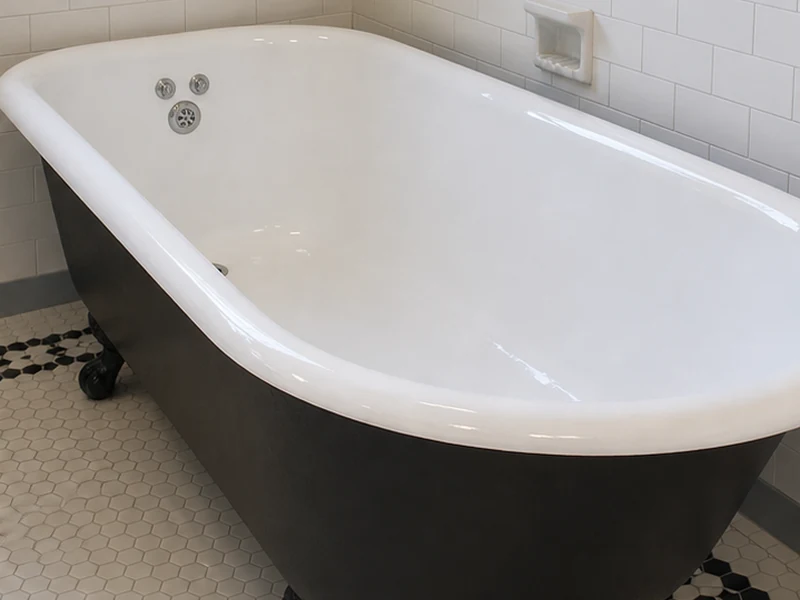
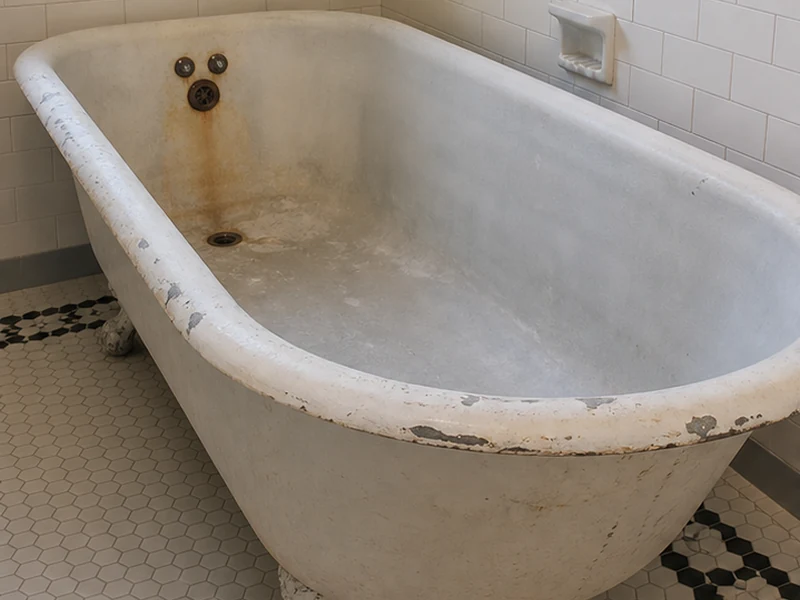 Before
After
Before
After
Santa Clara customer reviews
Our 1940s clawfoot was rust-stained and chalky inside. They refinished it in place, sprayed the outside a deep navy, and the feet look hand-detailed. It looks like the day it was cast.
— Diane R., Old Quad
We almost replaced our antique tub during a Westwood Oaks remodel. So glad we didn't — the interior is glass-smooth and the matte charcoal exterior is exactly what we wanted. Done in a day.
— Marcus L., Westwood Oaks
The rust around the drain on our roll-top was bad. They ground it back, sealed it, and you'd never know it was there. Clean, professional, and the warranty was in writing.
— Priya N., Forest Park
Clawfoot & antique tub FAQ
What's the difference between reglazing, refinishing and resurfacing?
Nothing — all three words describe the same job: bonding a fresh acrylic-urethane coating to a cleaned, etched surface. They differ from a tub liner (a plastic shell dropped over the old tub) and from full replacement. For an antique clawfoot, refinishing keeps the cast-iron body and renews only the worn glaze.
Do I have to move my antique tub to refinish it?
No. We mask and ventilate around the tub and refinish it where it sits, so a heavy cast-iron clawfoot never has to be carried out of the bathroom. Moving an antique tub risks cracking the iron and disturbing old plumbing.
Can you fix rust and chips in a vintage cast-iron tub?
Yes. We grind out rust spots back to sound metal, fill chips and gouges with a polyester or epoxy filler, sand them level, and seal them under primer before the topcoat. Untreated rust will bleed through any finish, so the repair has to happen first.
Can I choose the color for my clawfoot tub?
Yes. The interior is usually finished in bright white or a soft off-white, and the exterior can be sprayed in almost any color — classic black, deep navy, sage or a custom match. We confirm the color with you before any coating goes down.
Is there lead paint on an old clawfoot tub?
Often, yes — roughly 60–70% of pre-1978 painted clawfoot exteriors carry lead-based paint. Don't sand or scrape an old painted shell yourself, since that releases lead dust. We contain the room, work the surface wet, and strip and seal it safely under a fresh sprayed color coat.
What kinds of antique tubs do you refinish?
Roll-rim (roll-top), slipper and double-slipper, double-ended, and pedestal tubs, in both cast iron and lighter vintage pressed steel. The repair-etch-prime-spray process is the same across all of them; only the handling, masking and edge repair change with the body type.
How much more does a clawfoot cost than a standard tub?
About 50% more once the exterior is included. Interior-only refinishing is $729–$890, the same as a standard alcove tub, while a full interior-plus-exterior restoration with detailed feet runs $950–$1,150. The difference is the labor of finishing every side, not a markup.
How do I care for a refinished clawfoot tub?
Use a non-abrasive liquid cleaner and a soft cloth, skip scouring powders and abrasive pads, and avoid bath mats with suction cups that trap water against the finish. Cared for this way, a sprayed acrylic-urethane interior holds its gloss for 10–15 years.
Are you licensed and insured, and is the work warrantied?
Yes. Santa Clara Bathtub Refinishing is fully licensed and insured, carrying liability and workers' coverage. Every antique tub restoration is backed by a 5-year written warranty against peeling and adhesion failure, with the paperwork left with you when the job is done.
Why do DIY refinishing kits peel on old tubs?
Drugstore kits skip the acid/silane etch and the bonding primer and ask you to brush or roll over glossy porcelain the coating cannot grip. On a century-old clawfoot with rust and chalking, that finish lifts within a year. Professional prep is why a sprayed finish lasts 10–15 years.
Restore your Santa Clara clawfoot tub
Open Mon–Sat 8 AM–6 PM. Fully licensed & insured, with a 5-year written warranty.